This post contains affiliate links. If you buy through them, brewing.com earns a commission at no cost to you. How we pick products
Coffee · Equipment
Home Espresso Machines: How to Read the Specs That Matter
Thermoblock versus single boiler, what PID really controls, why 58mm decides your upgrade path, and the reason 15 bar is a marketing number. Two machines, one grinder warning.
Affiliate disclosure: brewing.com earns a commission from qualifying Amazon purchases. Picks are editorial and not based on hands-on lab testing. How we pick products
| Pick | Best for | Price |
|---|---|---|
| Breville Barista Express BES870XL | Best all-in-one starting point | $689.99 ↗ as of 17 Sep 2026, 2:18am GMT+0000 Details (paid link) |
| Gaggia Classic E24 (RI9380/46) | Best long-term platform | $451.90 ↗ as of 17 Sep 2026, 2:18am GMT+0000 Details (paid link) |
| Baratza Encore | The grinder question | $149.95 ↗ as of 17 Sep 2026, 2:18am GMT+0000 Details (paid link) |
Prices come from Amazon and refresh nightly. A pick shows “Check price” when we do not have a current figure for it.
Home espresso is the only corner of coffee where spending more money reliably makes the coffee worse before it makes it better, because the machine is rarely the limiting factor. This guide is for someone who already drinks espresso, already knows they want to pull their own shots, and is trying to work out what separates a $450 machine from a $700 one and whether either of them will make a flat white worth drinking at home. If you are mainly after convenience and one button, a superautomatic or a pod machine is the honest answer and this guide is not for you.
What actually makes espresso hard
Espresso is water at roughly 93°C forced through a compacted puck of very finely ground coffee at around nine bars of pressure, for about 25 to 30 seconds. Every part of that sentence is a tolerance. Move the temperature by two degrees and the shot turns sour or bitter. Move the grind by a hair and the same dose runs in twelve seconds or ninety.
That is why the machine specifications that matter are the ones governing stability — how well it holds temperature and pressure while you are not looking — and why the grinder matters more than the machine at this price. A great machine with a bad grinder makes bad espresso every time. A modest machine with a good grinder makes good espresso most of the time.
How the machine heats water, and why it decides everything else
There are four architectures, and the price tiers map onto them almost exactly.
- Thermoblock / thermocoil. A heating element wrapped around a narrow water channel, heating on demand. It reaches temperature in seconds and uses little energy. The classic weakness is temperature stability across a shot, which is why the good implementations pair it with electronic PID control. You cannot brew and steam simultaneously.
- Single boiler, dual use. One boiler that heats to brew temperature, then heats further to make steam. Cheap, robust, and the architecture behind most of the enthusiast machines people keep for a decade. The cost is the wait: brew, then wait for the boiler to climb to steam temperature, then wait again — or run water through — to come back down. Roughly a minute each way.
- Heat exchanger. One boiler held at steam temperature with a tube running through it that heats brew water in transit. Brew and steam at the same time, from one boiler. The quirk is that the water in that tube overheats while idle, so you “cool flush” a few seconds of water before each shot. This architecture starts well above the price band here.
- Dual boiler. Two separate boilers, each held at its own temperature. No waiting, no flushing, independent control of both. It is the correct answer and it costs roughly double everything in this guide.
PID: what it means and what it does not
A basic machine uses a thermostat: heat until too hot, stop, coast down until too cold, heat again. The water temperature sits inside a band several degrees wide, and where in that band your shot lands is luck. A PID controller instead measures continuously and modulates the element to hold a setpoint, cutting that swing dramatically.
Two honest caveats. First, PID controls the boiler or block temperature, not the water temperature at the coffee — the grouphead’s thermal mass still has to be up to temperature, which is why every machine here needs 15 to 25 minutes of warm-up regardless of what its display says. Second, a PID with no adjustable setpoint gives you consistency but not control. Both are worth having; only one of them lets you chase a lighter roast.
The 58mm question
Commercial espresso standardised on a 58mm portafilter decades ago. That single number quietly determines your entire upgrade path. On a 58mm machine, every bottomless portafilter, every precision basket, every tamper, every distribution tool and puck screen on the market fits, from every manufacturer, forever. Smaller formats — 54mm and 51mm — have real but much thinner accessory ecosystems, and the parts cost more because fewer people make them.
This is not a coffee-quality argument. A 54mm machine is not inherently worse in the cup. It is a lock-in argument, and it matters if you expect to still be improving this setup in three years.
Steam, and why milk drinks are the real test
Steaming milk properly needs dry steam — steam with little liquid water in it — delivered with enough force to spin a pitcher into a vortex. Weak steam injects water into your milk and you get bubbly, thin, watery foam that separates before you reach the table. The things that produce good steam are boiler mass and boiler temperature, which is why single-boiler machines with real brass boilers often steam better than more expensive-looking thermoblock machines.
Also relevant: the number of holes in the steam tip, and whether the wand has a joint that lets you get the pitcher at an angle. A one-hole tip is slow but very controllable and forgiving for a beginner; multi-hole tips are faster and less patient.
“15 bar” is a marketing number
Nearly every machine in this price band advertises a 15-bar pump, and espresso is brewed at nine. Both statements are true and the gap is worth understanding, because it is the most common specification confusion in home espresso.
The 15 bar figure is the maximum dead-head pressure of the vibratory pump inside — what it can produce against a closed valve. What reaches the coffee is set by an over-pressure valve that bleeds the excess off, and that valve is typically factory-set around nine bars. So a higher advertised bar rating tells you nothing about shot quality; a machine advertising 20 bar is not making better espresso than one advertising 15.
What is genuinely useful to know is that the OPV is an adjustable part on most enthusiast machines. Lowering it to six or seven bars is one of the most common and most worthwhile modifications people make, particularly for modern lighter roasts. Whether your machine’s OPV is reachable and adjustable is a real differentiator between a repairable platform and a sealed appliance.
The other pump distinction: vibratory versus rotary. Everything at this price is vibratory — small, cheap, and loud in short bursts. Rotary pumps are quieter, smoother, and live in machines that plumb into a water line, several times above this budget. It is not a decision you get to make here.
Pressurised baskets: the thing that hides your mistakes
Most machines in this band ship with both pressurised (dual-wall) and non-pressurised (single-wall) baskets. A pressurised basket has a tiny restrictor hole that creates back-pressure artificially, so almost any grind produces something that looks like espresso with crema on top. It is a training-wheel: it makes bad grinding survivable, and it caps how good the shot can be.
If you intend to learn espresso rather than approximate it, you will move to the single-wall baskets — and the moment you do, your grinder becomes the entire ballgame.
The machines

Best all-in-one starting point
Breville Barista Express BES870XL
Why it fits
The only machine here that includes a grinder, and for a first espresso setup that is the decisive fact — a separate espresso-capable grinder typically costs as much again. It is a thermocoil machine with electronic PID temperature control, a 15-bar pump that extracts at 9 bar, low-pressure pre-infusion, an 18g target dose and a built-in conical burr grinder with 16 settings. The integrated dose-and-tamp workflow and the pressure gauge give a beginner immediate feedback about whether the grind is right, which is the hardest thing to learn without it.
Limitations
54mm portafilter, not the 58mm commercial standard, so the accessory ecosystem is narrower and the parts pricier. Thermocoil means you cannot brew and steam at once, and steam power is modest next to a real boiler. The 16 grind settings are stepped and can feel coarse between steps once you are chasing lighter roasts. Servicing is Breville-only.
Best long-term platform
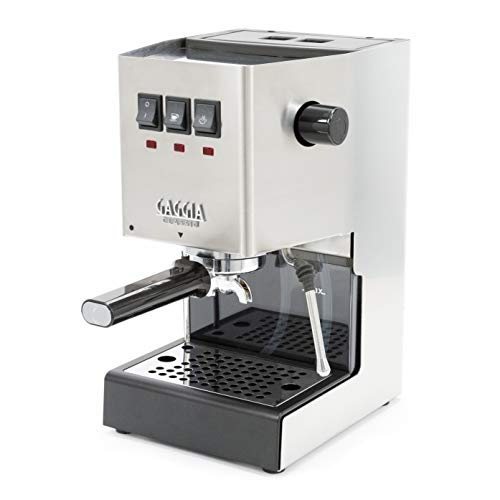
Gaggia Classic E24 (RI9380/46)
Why it fits
58mm commercial portafilter and grouphead, which means the entire aftermarket fits it for as long as you own it. The E24 revision uses a lead-free brass boiler with more mass than the aluminium boilers it replaced, and mass is what buys you temperature stability and steam power. A single 1425W boiler, a chrome-plated brass grouphead, a commercial-style steam wand, 9-bar extraction, and three baskets including a 14g single-wall double. The Classic family is the most documented, most repairable, most modified machine in home espresso — parts, teardowns and upgrade paths are everywhere.
Limitations
No grinder, and no PID from the factory — it runs a thermostat, so shot-to-shot temperature is a band rather than a number. Single boiler dual use, so brewing then steaming means waiting on the temperature climb. It expects you to learn; there is no gauge or guided workflow telling you what went wrong.

The grinder question
Baratza Encore
Why it fits
Included here because the Gaggia has no grinder and pairing one is a decision you cannot skip. The Encore earns its reputation on serviceability — Baratza publishes exploded diagrams and sells every internal part, so it is a grinder you repair rather than replace. If you also brew filter coffee, it is excellent at that job.
Limitations
Read this before you buy it: Baratza positions the Encore as a filter grinder, and built a separate model, the Encore ESP, specifically because the standard Encore's adjustment range and step size are not really suited to espresso. Do not buy this one as your espresso grinder. Buy it if filter is half your coffee life, and budget an espresso-capable grinder separately.
How to choose between them
- You own no grinder and want to be pulling shots this weekend: the Barista Express. One box, one budget, one learning curve instead of two.
- You already own a stepless espresso grinder: the Gaggia, without much hesitation. You have already paid for the hard part, and the 58mm platform is where the money should go.
- You expect to still be tinkering in five years: the Gaggia. PID kits, OPV adjustment, bottomless portafilters and steam wand swaps are all documented and reversible. The Breville is a sealed appliance by comparison.
- Milk drinks are 90% of what you make: the Gaggia’s brass boiler is the better steamer, but the Breville is the more forgiving whole system. If you want one cappuccino at a time, either works; if you want four in a row for guests, neither is a dual boiler and both will make you wait.
- You want espresso-shaped coffee with minimum fuss: the Barista Express on its pressurised baskets does that honestly, and there is nothing wrong with stopping there.
Costs nobody mentions in the listing
- The grinder, if the machine does not include one. This is the single largest hidden cost in home espresso and the one people discover after the machine arrives. A genuinely espresso-capable grinder is a machine-sized purchase, not an accessory-sized one.
- A scale that reads to 0.1g. Espresso is a ratio — dose in, yield out. Without a scale you are guessing at the only two numbers that define the shot.
- A real tamper. The plastic one in the box is a placeholder on nearly every machine in this band.
- Water treatment. Hard water scales a boiler until it fails; water with no mineral content at all extracts badly and corrodes. If you are on hard municipal water, filtered or remineralised brewing water is not optional — descaling schedules exist because people skip this.
- A knock box and a bottomless portafilter. The first is a quality-of-life item; the second is the only diagnostic tool that shows you channelling in your puck.
- Beans, fresher and faster than you think. Espresso wants coffee roasted within a few weeks, and dialling in a new bag costs you several shots. Factor coffee you pour down the sink into the running cost.
- Counter space and warm-up time. Twenty minutes of warm-up means these machines live plugged in on the counter, not in a cupboard.
How these picks were made
We have not pulled shots on these machines side by side, and we do no hands-on testing of any kind. The picks above are based on published manufacturer specifications — boiler type and material, wattage, portafilter size, temperature control method, included baskets — plus the structural arguments about architecture and accessory standardisation set out earlier in this guide, and on how well each manufacturer supports repair and replacement parts. Where a machine’s reputation rests on something we cannot verify from specifications, we have not asserted it. Prices come from Amazon and refresh nightly; espresso machine pricing moves frequently, so confirm on the product page before buying.
Shop this guide